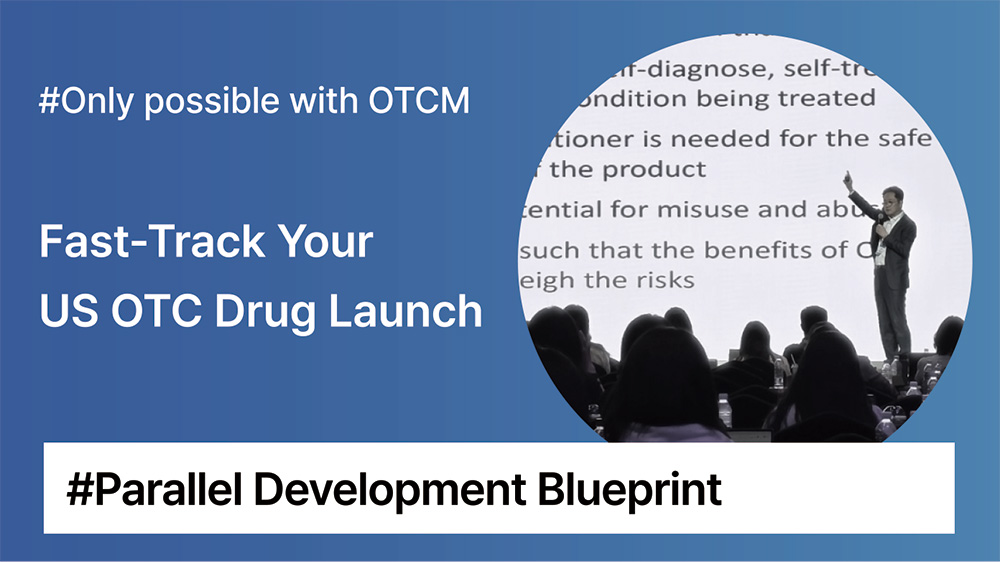
The questions brands preparing to export to United States ask most often — answered by OTC experts.
An OTC (Over-The-Counter) drug is a medicine consumers can buy and use directly without a prescription.
In the United States, products that claim certain effects — such as sunscreens or acne treatments — may be classified as OTC drugs, and must comply with the active ingredients, concentrations, labeling and manufacturing standards set by the FDA.
A product sold in Korea as a functional cosmetic may still be classified as an OTC drug in the United States, so a regulatory review is required before export.
OTCM provides specialized ODM services for entering the US OTC market.
Fast development and production: roughly 6 months when an existing formulation is used; new formulations require an additional development period.
Reasonable cost: we minimize the cost burden of OTC product development and registration to support efficient market entry.
Flexible MOQ: minimum order quantities are set at a practical level so brands of any size can produce flexibly.
Reliable manufacturing capability: products are made on the technology and quality systems of a raw-material company holding FDA API manufacturing certification.
Beyond manufacturing alone, OTCM provides integrated support across development, production, quality control and regulatory response for successful entry into the US OTC market.
It may be.
The United States has no equivalent of Korea's "functional cosmetic" category. Whether a product is an OTC drug is judged on its ingredients, claimed effects and advertising language.
No. Korea's functional cosmetic concept and the US OTC concept are different.
What matters is whether the product is intended to diagnose, cure, mitigate, treat or prevent disease, or to affect the structure or function of the body.
For this reason a product with more than one intended use can meet the definitions of both a cosmetic and a drug at the same time.
Is it a cosmetic, a drug, or both?
Yes. Even a make-up product is treated as an OTC drug once it carries an SPF claim or claims UV-protection performance.
There is currently no striae (stretch-mark) reduction category in the US OTC Monograph system.
However, claims such as "treatment" or "repair" can raise drug-classification issues.
In practice these must be reviewed before formulation development begins.
An OTC Monograph is effectively a recipe book set by the FDA for OTC drugs.
A product meeting all of the conditions below set out in the relevant Monograph may be marketed as an OTC drug without separate pre-approval.
A non-monograph OTC product, by contrast, falls outside those conditions.
Such cases are regarded as outside the scope of the Monograph.
Note: listing in a Monograph does not in itself mean every active ingredient is GRASE (Generally Recognized As Safe and Effective).
Sunscreens in the United States are governed by the OTC Sunscreen Monograph (M020).
The FDA classifies UV-filter active ingredients as follows, based on safety and efficacy assessment.
Ingredients generally recognized as safe and effective. Those currently recognized by the FDA as GRASE are:
BEMT was added to the OTC Sunscreen Monograph in June 2026 through FDA Final Administrative Order OTC000039. After reviewing the submitted data the FDA determined BEMT to be GRASE for sunscreens for adults and children aged 6 months and older.
Ingredients not recognized as GRASE. These will not be included in the final monograph. Category II ingredients are:
Ingredients for which the FDA has not reached a final conclusion because safety or efficacy data are insufficient. These include:
Practical note: Category III does not mean "prohibited". The FDA is still reviewing additional safety data, and these ingredients remain in use under Monograph conditions.
Where a product is not covered by an existing OTC Monograph, or falls outside Monograph conditions such as permitted ingredients, concentration or combinations, an NDA, ANDA or OMOR must be considered depending on the situation.
NDA (New Drug Application) — where safety and efficacy must be demonstrated for a new ingredient, new indication or new conditions of use
ANDA (Abbreviated New Drug Application) — for a generic drug identical to an already FDA-approved Reference Listed Drug (RLD)
OMOR (OTC Monograph Order Request) — where an existing OTC Monograph is to be amended or new OTC conditions added
For US OTC sunscreens, SPF and Broad Spectrum claims must be based on data generated under the test conditions of 21 CFR 201.327, and are evaluated against results produced using the study design required by that regulation.
The United States also does not use labeling systems such as UVA/PA or UVA-PF; UVA performance is assessed by whether the Broad Spectrum criterion is met.
Using a Korean test report as-is is therefore generally not accepted, and testing must satisfy US study design and conditions.
Such testing can be commissioned through the SCRC clinical centre, where specialist researchers support the entire process from study design and conduct through to data management. SCRC is a clinical research organization specializing in global skincare and sunscreen evaluation, performing human application testing and UV-protection assessment to the standards of markets including the United States, Korea, Southeast Asia and Europe.
The first thing to establish when entering the US market is the legal classification of the product — cosmetic or OTC drug.
That classification completely changes the applicable regulatory framework (MoCRA vs OTC Monograph), the labeling requirements and the registration procedure.
The boundary is whether the product prevents or treats disease, or alters the structure or function of the body.
Cosmetic claims: improving the appearance of skin (moisturizing, brightening, smoothing and similar)
In the United States the same product may be classified as an OTC drug depending on the claims made.
Where the product carries OTC drug claims such as SPF or acne treatment, OTC drug labeling rules (Drug Facts) take precedence.
Cosmetic functions such as moisturizing or texture improvement may be presented alongside, but only to a limited extent and without causing confusion with the OTC indications.
The US FDA reviews primarily whether product claims are consistent with the applicable regulatory standards.
A product with UV-protection function to which OTC drug requirements such as Drug Facts have not been applied
Acne, anti-aging or whitening functions expressed in a way that could be understood as a treatment or curative effect
A cosmetic product containing wording that amounts to an OTC drug claim
In such cases the FDA may request labeling corrections or additional documentation, and this can escalate to a Warning Letter.
It is therefore important to align claims and regulatory classification consistently at the product development stage.
Note: this FAQ is general guidance for understanding the US cosmetic and OTC drug systems. Individual review is required for each product depending on its formulation, labeling, claims and sales format.



![[One Year of OTCM] How OTCM Became a Trusted Manufacturing Partner](../../ezs_data/board/table_201/5_1783671512.jpg)