USA (OTC)

OTC Development Process

OTCM's differentiated OTC development rests on two core elements: a parallel development process and a white-label strategy.
Beyond simply shortening the development timeline, these two strategies let brands respond nimbly to market changes and customer needs.

OTCM's Differentiated Development Strategy

Start from a proven formula, and run multiple stages at the same time.

White-Label Strategy

OTCM offers customized design to clients on the basis of already-proven products.Using products whose base formula and formulation stability are already validated speeds up market entry while minimizing risk.

Parallel Development

A one-stop approach in which clinical testing, stability testing and regulatory review run concurrently, minimizing bottlenecks so there is no unnecessary waiting.The result is a fast product launch and secured stability at the same time.

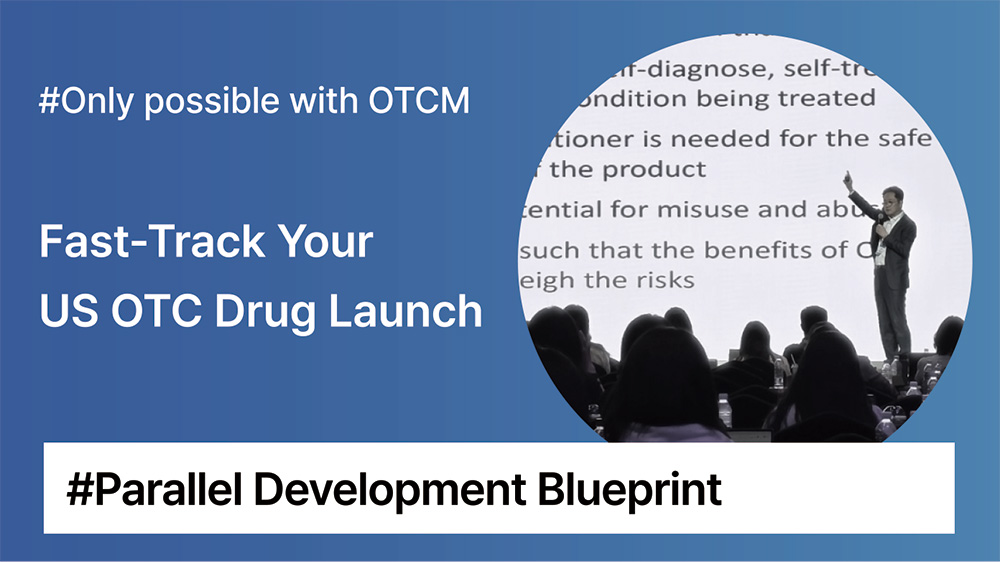
Accelerating Time-to-Market: The Parallel Development Process

Generally, manufacturers follow a sequential approach to minimize risks. Leveraging our extensive library of formulation data and proven OTC development expertise, OTCM runs these phases in parallel, drastically shortening the development timeline.

Approx. 2 months

Formulation Development

We don't start every project from scratch.By utilizing our pre-validated OTC formulation library, we optimize fragrances and active marketing ingredients to finalize formulas in the shortest time possible.

Concurrent with formulation development

Clinical Testing

Clinical trials begin the moment the formulation is locked in.Because OTCM operates a specialized clinical institution (SCRC) as a subsidiary, we manage the entire schedule directly without any waiting periods associated with external agencies.

In parallel with the development phase

Stability Testing

OTC products require stability evaluations conducted under environments that replicate actual production conditions.With production infrastructure spanning from pilot-scale to commercial-scale facilities, OTCM performs testing and mass-production preparation simultaneously.

OTC Sunscreen Development Process

Through the parallel development process, products that meet FDA OTC requirements are launched quickly.

STEP 1

R&D

The formula is finalized and the required clinical tests are carried out.

STEP 2

Packaging

Covers the whole process from packaging selection and label design to compatibility testing and procurement.

STEP 3

Stability Testing

Accelerated and long-term tests confirm the stability of the product.

STEP 4

Validation

Test-method and process validation are completed and the production plan is established.

STEP 5

Commercial Production

With every step complete, the OTC product is released in earnest.

STEP 6

Supply Agreement

Pricing, purchase orders and product registration prepare the product for market entry.

STEP 7

Annual Product Quality Review

Quality is reviewed continuously after launch to maintain trust.

Regulatory Documentation and OTC-Dedicated Production Infrastructure

Regulatory Documentation

Project completion does not end with product development. Once accelerated stability data is secured, manufacturing documentation and process validation (PV) — manufacturing, filling, cleaning and storage — must follow before commercialization.Supported by the quality management systems and regulatory know-how inherited from our parent company's API (Active Pharmaceutical Ingredient) manufacturing business, OTCM provides systematic assistance throughout this entire process.

OTC-Dedicated Production Infrastructure

From its inception, OTCM designed and built a smart-factory-based finished-product facility with OTC production in mind.The plant is designed to prevent cross-contamination, with weighing, manufacturing and storage zones systematically segregated to minimize any risk of raw material mix-ups. This design also serves as a powerful advantage for Halal-certified manufacturing.

Entering the US OTC market is not just about manufacturing a sunscreen.
It is a highly complex project where development, clinical trials, regulations, production and documentation must move as one system.

By bridging our parent company's API manufacturing capabilities, FDA regulatory experience and dedicated OTC infrastructure into one,
OTCM empowers brands to enter the US market faster and more efficiently.

FDA Registration Process for Sunscreen Products

The first gateway to launch after development.

STEP 1

Establishment Registration

First, the manufacturing site must be proven to meet FDA requirements and be registered.Information on registered establishments can be looked up by anyone on the FDA website.What to prepare

  • FEI number — the unique facility identifier assigned by the FDA on registration
  • DUNS number — acts as an international business registration number; prepare in advance

STEP 2

NDC Code

The NDC code, a unique identifier for each product, is obtained from the FDA by the marketer (usually the brand owner or distributor).It consists of 10 digits.

  • ① Labeler code — assigned by the FDA, 5 digits
  • ② Product code — created by the company, 3–4 digits
  • ③ Package code — created by the company, 1–2 digits

STEP 3

Drug Listing

Product information including the unique number is listed with the FDA.Listed information can be checked on DailyMed, the public database of the U.S. National Library of Medicine. Any change to product information after listing must be updated immediately so it always stays current.Information required

  • NDC number
  • Product name
  • Dosage form
  • Route of administration (topical)
  • Ingredients — active ingredients with their strength
  • Packaging information
  • Manufacturer information (DUNS)
  • Labeling (artwork)

아이콘
Clinical Research
Location
Inquiry