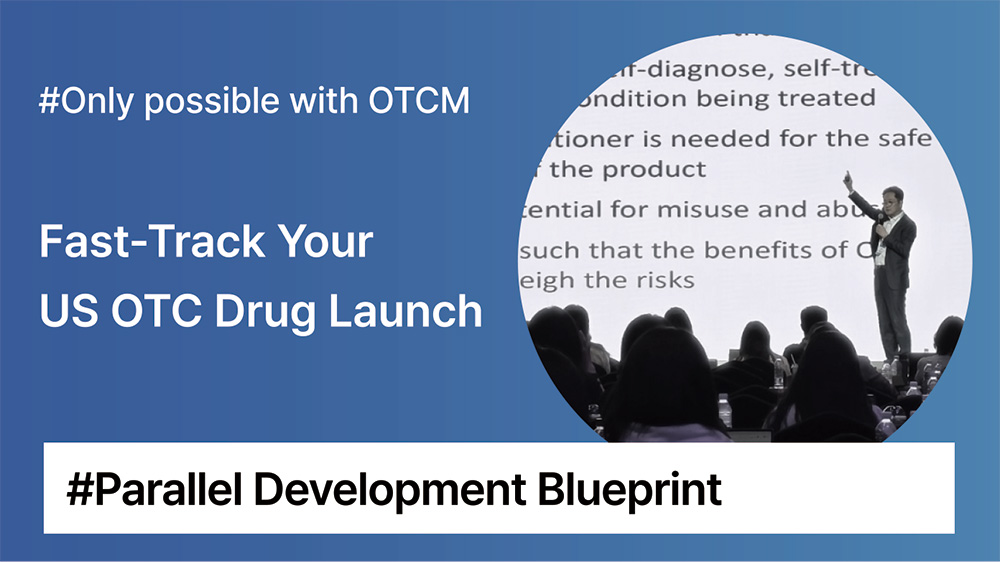
From US FDA OTC to the EU, China, Japan, ASEAN, Australia and Halal — the questions brands preparing to export ask most often, answered by OTC experts.
An OTC (Over-The-Counter) drug is a medicine consumers can buy and use directly without a prescription.
In the United States, products that claim certain effects — such as sunscreens or acne treatments — may be classified as OTC drugs, and must comply with the active ingredients, concentrations, labeling and manufacturing standards set by the FDA.
A product sold in Korea as a functional cosmetic may still be classified as an OTC drug in the United States, so a regulatory review is required before export.
OTCM provides specialized ODM services for entering the US OTC market.
Fast development and production: roughly 6 months when an existing formulation is used; new formulations require an additional development period.
Reasonable cost: we minimize the cost burden of OTC product development and registration to support efficient market entry.
Flexible MOQ: minimum order quantities are set at a practical level so brands of any size can produce flexibly.
Reliable manufacturing capability: products are made on the technology and quality systems of a raw-material company holding FDA API manufacturing certification.
Beyond manufacturing alone, OTCM provides integrated support across development, production, quality control and regulatory response for successful entry into the US OTC market.
It may be.
The United States has no equivalent of Korea's "functional cosmetic" category. Whether a product is an OTC drug is judged on its ingredients, claimed effects and advertising language.
No. Korea's functional cosmetic concept and the US OTC concept are different.
What matters is whether the product is intended to diagnose, cure, mitigate, treat or prevent disease, or to affect the structure or function of the body.
For this reason a product with more than one intended use can meet the definitions of both a cosmetic and a drug at the same time.
Is it a cosmetic, a drug, or both?
Yes. Even a make-up product is treated as an OTC drug once it carries an SPF claim or claims UV-protection performance.
There is currently no striae (stretch-mark) reduction category in the US OTC Monograph system.
However, claims such as "treatment" or "repair" can raise drug-classification issues.
In practice these must be reviewed before formulation development begins.
An OTC Monograph is effectively a recipe book set by the FDA for OTC drugs.
A product meeting all of the conditions below set out in the relevant Monograph may be marketed as an OTC drug without separate pre-approval.
A non-monograph OTC product, by contrast, falls outside those conditions.
Such cases are regarded as outside the scope of the Monograph.
Note: listing in a Monograph does not in itself mean every active ingredient is GRASE (Generally Recognized As Safe and Effective).
Sunscreens in the United States are governed by the OTC Sunscreen Monograph (M020).
The FDA classifies UV-filter active ingredients as follows, based on safety and efficacy assessment.
Ingredients generally recognized as safe and effective. Those currently recognized by the FDA as GRASE are:
BEMT was added to the OTC Sunscreen Monograph in June 2026 through FDA Final Administrative Order OTC000039. After reviewing the submitted data the FDA determined BEMT to be GRASE for sunscreens for adults and children aged 6 months and older.
Ingredients not recognized as GRASE. These will not be included in the final monograph. Category II ingredients are:
Ingredients for which the FDA has not reached a final conclusion because safety or efficacy data are insufficient. These include:
Practical note: Category III does not mean "prohibited". The FDA is still reviewing additional safety data, and these ingredients remain in use under Monograph conditions.
Where a product is not covered by an existing OTC Monograph, or falls outside Monograph conditions such as permitted ingredients, concentration or combinations, an NDA, ANDA or OMOR must be considered depending on the situation.
NDA (New Drug Application) — where safety and efficacy must be demonstrated for a new ingredient, new indication or new conditions of use
ANDA (Abbreviated New Drug Application) — for a generic drug identical to an already FDA-approved Reference Listed Drug (RLD)
OMOR (OTC Monograph Order Request) — where an existing OTC Monograph is to be amended or new OTC conditions added
For US OTC sunscreens, SPF and Broad Spectrum claims must be based on data generated under the test conditions of 21 CFR 201.327, and are evaluated against results produced using the study design required by that regulation.
The United States also does not use labeling systems such as UVA/PA or UVA-PF; UVA performance is assessed by whether the Broad Spectrum criterion is met.
Using a Korean test report as-is is therefore generally not accepted, and testing must satisfy US study design and conditions.
Such testing can be commissioned through the SCRC clinical centre, where specialist researchers support the entire process from study design and conduct through to data management. SCRC is a clinical research organization specializing in global skincare and sunscreen evaluation, performing human application testing and UV-protection assessment to the standards of markets including the United States, Korea, Southeast Asia and Europe.
The first thing to establish when entering the US market is the legal classification of the product — cosmetic or OTC drug.
That classification completely changes the applicable regulatory framework (MoCRA vs OTC Monograph), the labeling requirements and the registration procedure.
The boundary is whether the product prevents or treats disease, or alters the structure or function of the body.
Cosmetic claims: improving the appearance of skin (moisturizing, brightening, smoothing and similar)
In the United States the same product may be classified as an OTC drug depending on the claims made.
Where the product carries OTC drug claims such as SPF or acne treatment, OTC drug labeling rules (Drug Facts) take precedence.
Cosmetic functions such as moisturizing or texture improvement may be presented alongside, but only to a limited extent and without causing confusion with the OTC indications.
The US FDA reviews primarily whether product claims are consistent with the applicable regulatory standards.
A product with UV-protection function to which OTC drug requirements such as Drug Facts have not been applied
Acne, anti-aging or whitening functions expressed in a way that could be understood as a treatment or curative effect
A cosmetic product containing wording that amounts to an OTC drug claim
In such cases the FDA may request labeling corrections or additional documentation, and this can escalate to a Warning Letter.
It is therefore important to align claims and regulatory classification consistently at the product development stage.
Note: this FAQ is general guidance for understanding the US cosmetic and OTC drug systems. Individual review is required for each product depending on its formulation, labeling, claims and sales format.
Cosmetics in the EU are regulated under Regulation (EC) No 1223/2009.
The EU does not operate a separate pre-approval system, but before a product is placed on the market it must meet requirements including a safety assessment, appointment of a Responsible Person (RP), preparation of a Product Information File (PIF) and CPNP notification.
Ingredient restrictions, labeling, advertising claims, packaging and recycling obligations must also be reviewed.
In other words, the EU is not a market where you obtain an approval — it is a market where the company itself must demonstrate the safety and regulatory compliance of its products.
Regulation (EC) No 1223/2009 is the core legislation setting out safety, ingredients, labeling, appointment of a Responsible Person and market placement requirements for cosmetics in the EU.
All 27 EU member states apply the same cosmetics regulation, so once the requirements are met a product can be sold throughout the EU.
To place a cosmetic on the EU market you must appoint a Responsible Person (RP) established in the EU.
The RP verifies that the product complies with the EU Cosmetics Regulation (EC) No 1223/2009 and bears responsibility for the product, including keeping the PIF, making the CPNP notification, dealing with authorities, managing undesirable effects and handling recalls.
Every cosmetic sold in the EU must therefore be managed through an RP in the EU.
The PIF is the product information dossier used to demonstrate the safety and regulatory compliance of an EU cosmetic.
The PIF must be kept at the RP's address and be available for submission at the request of market surveillance authorities.
The CPSR (Cosmetic Product Safety Report) is the cosmetic safety assessment report.
Before a product is placed on the EU market, a qualified safety assessor must comprehensively review its ingredients, conditions of use, consumer exposure and toxicological information, and assess whether the product can be used safely.
Article 10 of Regulation (EC) No 1223/2009 also sets out the qualification requirements for safety assessors. The assessment must be carried out by an expert holding a degree or equivalent formal qualification following a university course in pharmacy, toxicology, medicine or a similar discipline recognized as equivalent.
The CPSR is therefore not merely paperwork — it is a core safety document in which a qualified expert scientifically assesses the safety of the product.
The CPNP (Cosmetic Products Notification Portal) is the online cosmetic notification system operated by the European Commission.
Before placing a cosmetic on the EU market you must register product information, ingredient information, Responsible Person (RP) details and label images. This is known as CPNP notification.
CPNP is a notification system, not an approval system. Completing a notification does not mean the safety or compliance of the product has been reviewed or approved. Responsibility for regulatory compliance rests with the RP and the company.
The EU manages cosmetic ingredients through the Annex system of Regulation (EC) No 1223/2009.
Colorants, preservatives and UV filters in particular may in principle only be used if listed in the relevant Annex, and the prescribed conditions on concentration, product type and warnings must be observed.
EU ingredient rules are also revised continuously in line with scientific assessment, so it is important to check the latest provisions before launching a product.
Even a product lawfully sold in Korea can only be placed on the EU market once it satisfies the EU Cosmetics Regulation.
Requirements differ between Korea and the EU in areas such as ingredient restrictions, fragrance allergen labeling, preparation of the CPSR and PIF, and labeling and advertising standards. Separately regulated ingredients such as UV filters, preservatives and colorants may also have different conditions of use or permitted ranges.
A separate regulatory review is therefore required before exporting to the EU.
Missing or inaccurate labeling can attract market surveillance action, so it is important to review label compliance thoroughly before launch.
Under Regulation (EU) No 655/2013 all claims in the EU must be supported by objective and verifiable evidence.
Expressions such as "Anti-Wrinkle", "Brightening" or "Clinically Proven", for example, may only be used where appropriate test data and scientific substantiation exist.
The EU applies Recommendation 2006/647/EC for sunscreen labeling, and the PA system used in Korea is not an official EU labeling system. The EU uses the UVA circle logo to indicate the level of UVA protection.
The UVA Protection Factor (UVAPF) must be at least one third of the SPF
The EU also discourages expressions that may mislead consumers, such as "sunblock" or "total protection", and recommends indicating an appropriate protection level according to the SPF value. Even a sunscreen that has been through functional cosmetic review in Korea therefore requires a separate review of SPF/UVA test results and labeling standards for EU sale.
Many companies assume that because the EU is a single market one English label is enough.
In practice, the language requirements of each country of sale must be met.
A product sold in Germany, for example, must provide directions for use and precautions in a language German consumers can understand, and France and Italy in particular apply relatively strict language requirements.
When entering the EU it is therefore important to review not only ingredient regulation but also a labeling strategy for each country of sale.
The EU in principle prohibits animal testing of finished cosmetic products and cosmetic ingredients, and prohibits marketing cosmetics that rely on animal test data.
There may nevertheless be cases requiring practical review in relation to data required under legislation other than the cosmetics regulation, such as REACH. It is therefore important to check animal testing documentation and supply chain information from the raw material selection stage onward.
The EU is not a market where you register once and finish — it is a market that must be managed continuously.
Where a formulation, raw material, manufacturing site or label changes, the PIF and CPNP information must also be kept up to date.
Because current information must be available for immediate submission at the request of market surveillance authorities, continuous document management is necessary after launch.
The key question is where the effect is expected to arise.
Products expected to have a general effect overall, such as cleansing or moisturizing the skin.
Japan operates a negative list of prohibited and restricted ingredients together with positive lists for certain permitted ingredients.
Products that, beyond cosmetic function, claim efficacy through specific active ingredients.
Typical examples include whitening, acne prevention, UV-related efficacy, deodorant and hair growth.
Both active ingredients and additives are controlled within permitted ranges.
No. They may be sold as either cosmetics or quasi-drugs.
Claims may focus on the physical blocking function of UV absorbers and scatterers.
UV-filter ingredients themselves are classified as additives, so the application must be made together with a separate active ingredient.
In that case the total amount of UV absorbers used as additives must not exceed 10%.
(Where a whitening active ingredient is included) Inhibits melanin production and prevents freckles and blemishes
SPF and PA testing is generally performed, but submission of the results is not mandatory for approval applications or notifications.
Separate test data may nevertheless be required depending on the sales strategy or customer requirements.
Whitening wording differs according to whether the product is a quasi-drug.
Active ingredients: arbutin, vitamin C derivatives, tranexamic acid, nicotinamide, kojic acid and others
Permitted wording: inhibits melanin production and prevents freckles and blemishes
Permitted wording: prevents freckles and blemishes caused by sunlight — mainly in connection with UV-protection function
The permitted scope differs between quasi-drugs and cosmetics.
Permitted wording: makes fine lines caused by dryness less noticeable. Using this wording may require evaluation testing in accordance with Japanese guidelines.
Yes. Naming systems can differ in particular between quasi-drugs and cosmetics.
Quasi-drug: nicotinamide (whitening or additive), niacinamide (wrinkle improvement)
When changing product type it is necessary to review the full ingredient list, approval documents and labeling wording together.
Note: this FAQ is general guidance for understanding the Japanese cosmetic and quasi-drug systems. Individual review is required for each product depending on its formulation, labeling, claims and sales format.
Many companies believe animal testing is unavoidable when exporting cosmetics to China, but the applicable requirements now differ according to product type and company qualifications.
China manages cosmetics as either general cosmetics or special cosmetics, and general cosmetics that meet certain conditions can be notified without submitting animal test data.
Special cosmetics, however, follow a separate approval and registration procedure, and additional documentation may be required depending on product safety and risk level. Chinese animal testing requirements must therefore be assessed comprehensively according to product type, company conditions and the registration route, rather than against a single standard.
China manages UV protection not as a simple topical cosmetic function but as an efficacy-driven function affecting the physiology of the skin.
Sunscreen products are therefore classified as special cosmetics rather than general cosmetics, and are subject to a stricter registration procedure and to submission of safety and efficacy documentation.
Even a sun care product distributed as a general cosmetic in the EU or ASEAN markets may be classified as a special cosmetic in China, so reviewing the product classification framework before market entry is essential.
China manages cosmetics as either general or special cosmetics. Special cosmetics include the following product groups:
sunscreens, whitening and blemish-improvement products, hair-loss prevention products, hair dyes and permanent wave products.
The same product may be classified differently under each country's regulatory framework, and classification as a special cosmetic can substantially increase the registration procedure, documentation and review period compared with a general cosmetic.
When exporting to China it is therefore important to review the regulatory classification criteria first, rather than the marketing wording.
Under the Standards for Cosmetic Efficacy Claim Evaluation, China requires submission of assessment documentation providing scientific support for the efficacy a product labels or advertises.
Depending on the type of claim — moisturizing, whitening, wrinkle improvement, UV protection and so on — the evidence may take the form of human application testing, consumer use testing, laboratory testing or literature-based documentation.
For certain claims, test data produced by a testing institution recognized by the Chinese authorities may be required, and the consistency between the claim and the study design is also reviewed.
Efficacy assessment documentation is not only a registration requirement but is also used as the basis for advertising and marketing wording, so it matters for advertising compliance after launch as well.
When entering the Chinese market it is therefore important to establish the claim strategy and the efficacy assessment strategy together from the earliest stage of product development.
Establishing a Chinese corporation is not necessarily required.
However, to register or notify a cosmetic in China you must appoint a Domestic Responsible Person in China.
The Domestic Responsible Person carries out product registration and notification on behalf of the overseas manufacturer, and bears responsibility across the product life cycle — including post-market safety management, adverse event reporting, product recall and dealing with the regulator.
They also retain product quality and safety documentation and act as the official channel of communication with the authorities, so they function as a core regulatory responsibility holder rather than a mere administrative agent.
Selecting the Domestic Responsible Person is therefore an important decision alongside the product registration strategy.
Since the Regulations on the Supervision and Administration of Cosmetics took effect, China has continuously strengthened its safety assessment system, institutionalizing an ingredient-based risk assessment framework in particular through the requirement to submit a Safety Assessment Report.
Product safety therefore no longer rests on finished-product test results alone; it is assessed comprehensively on scientific evidence including the toxicological information, human safety data, history of use and exposure assessment for each raw material.
Ingredient-level safety information is the key evidence used to prepare the Safety Assessment Report, so where that information is insufficient, requests for supplementary assessment may arise or the registration procedure may be delayed.
In the current Chinese regulatory environment, regulatory capability at the raw material selection and safety data stage — rather than at the finished product stage — has become the decisive factor in whether a product can be launched.
China applies safety management standards to cosmetics intended for children aged 12 and under that are stricter than those for general cosmetics.
Children's cosmetics are managed on a safety-first principle and may not claim adult functional efficacy such as whitening, acne improvement, body odour removal, hair removal, hair-loss prevention, hair dyeing or permanent waving.
New cosmetic ingredients, ingredients produced using genetic modification technology and nanomaterials are in principle restricted; where their use is necessary, scientific justification and safety substantiation are required.
China applies a minimum formula principle to children's cosmetics and also applies strict safety assessment criteria to the number and concentration of colorants, preservatives, surfactants and UV filters.
ASEAN (Association of Southeast Asian Nations) is an economic community of ten Southeast Asian countries.
The member states are Singapore, Malaysia, Thailand, Indonesia, Vietnam, the Philippines, Brunei, Cambodia, Laos and Myanmar, together forming one of the world's major consumer markets with a population of around 700 million.
In the cosmetics field, regulatory harmonization between member states is pursued on the basis of the ASEAN Cosmetic Directive (ACD), with a common framework covering prohibited substances, restricted substances, preservatives, colorants and UV filters.
Product registration, labeling, advertising control and post-market surveillance are nevertheless operated individually by each national authority, so country-specific rules must also be reviewed when entering ASEAN.
Many companies think of ASEAN as one market, but in practice the characteristics of each country are very distinct.
ASEAN shares a basic framework of cosmetic regulation through the ASEAN Cosmetic Directive (ACD), but product registration procedures, labeling, advertising control, import rules and post-market surveillance are operated separately by each national authority.
Consumer preferences and distribution environments also differ by country. In Indonesia, for example, halal-related enquiries are frequent, whereas Singapore has a relatively large premium beauty segment.
Rather than approaching ASEAN with a single strategy, it is therefore important to consider both the regulatory environment and the market characteristics of each target country.
Halal is one of the factors that cannot be left out when discussing the ASEAN market.
Indonesia in particular has the world's largest Muslim population, and Malaysia is also known for high consumer awareness of and market demand for halal. In practice it is not unusual to be asked for documentation on the origin of raw materials, the use of animal-derived ingredients, alcohol content and manufacturing processes, even where the product has no halal certification. Increasingly, consumers also consider halal as an indicator of product transparency and trustworthiness rather than for religious reasons alone.
If you are planning to enter the ASEAN market, reviewing raw materials and manufacturing processes from the product development stage can therefore help with later market expansion.
Driven by the Korean Wave and the growth of K-Beauty, Korean cosmetics have built strong recognition and trust in the ASEAN market. Many consumers associate Korean cosmetics with a trendy image and good quality.
As the market matures, however, it is becoming harder to compete on "Made in Korea" alone. Competition has intensified not only among Korean brands but with Japanese, European, American and local brands, and consumers increasingly compare ingredients, efficacy, sensory experience and price competitiveness in detail.
Even so, Korean cosmetics retain clear strengths in areas such as sun care, cushions and skincare, and positive perceptions of K-Beauty persist. Successful entry into ASEAN therefore calls for a strategy that uses the strength of "Korean cosmetics" while also taking local consumer needs and market characteristics into account.
Southeast Asia experiences strong ultraviolet radiation and high temperatures year round, and its sun care market continues to grow. Preference is high for light textures, formulations with little white cast, and sunscreens that layer well with make-up. Korean sunscreens attract steady interest in the ASEAN market on the strength of their sensory quality and range of formulations.
Interest in environmental impact is also increasing. Thailand, for example, restricts the use of sunscreens containing certain UV filters in some marine national parks in order to protect coral reefs. The policy covers products containing oxybenzone, octinoxate, 4-methylbenzylidene camphor and butylparaben, and is operated to protect marine ecosystems.
It is frequently cited as a trigger for the wider trend toward environmentally conscious product development such as reef-friendly sun care.
For sun care products aimed at ASEAN it is therefore important to review not only UV-protection efficacy but also the ingredients used, consumer perceptions on environmental matters and regulatory trends in each country.
Yes. ASEAN operates common principles for cosmetic advertising through the ASEAN Cosmetic Claims Guideline, and expressions of product efficacy must be based on objective evidence.
Because advertising and labeling control is administered by each national authority, however, additional requirements may arise.
Some ASEAN countries require the product notification number to be displayed (Indonesia, Thailand), and others require disclosure of animal-derived ingredients (Malaysia, Brunei, Vietnam). Thailand also requires nanomaterial labeling, and Indonesia operates a 2D barcode scheme for cosmetic packaging.
So although ASEAN operates on a common framework, additional country-specific requirements exist in practice, and country-by-country review is needed across advertising wording, labeling, product information and marketing materials as a whole.
Australia distinguishes cosmetics from therapeutic goods on the basis of the intended purpose of the product and its labeling and advertising claims.
Cosmetics are products for everyday beauty purposes such as cleansing the skin, imparting fragrance or improving appearance. Where a product claims acne improvement, antibacterial action, a functional therapeutic effect or a physiological action, it may be classified as a therapeutic good and fall under the Therapeutic Goods Administration (TGA), Australia's medicines regulator.
Australia has high levels of UV exposure and a high incidence of skin cancer, and operates a comparatively strict regulatory framework for sunscreens.
Australia classifies sunscreens as cosmetics or therapeutic goods not by product type alone but according to the primary purpose of the product and its labeling and advertising claims.
Where the primary purpose of the product is UV protection, it is generally classified as a therapeutic good and falls under the TGA.
In that case ARTG registration is required under the Therapeutic Goods Act 1989, with product registration and regulatory management carried out through a local sponsor.
Skincare products of SPF 15 or above where UV protection is claimed as a core function
Sunscreens containing insect repellent function or particular functional ingredients
Where UV protection is included but the primary purpose of the product is a cosmetic one such as skincare or colour, it may be classified as a cosmetic.
Even then, regulatory classification can change according to SPF level, product form, intended use and labeling wording, and a product exceeding certain thresholds may be reclassified as a therapeutic good.
Skincare products of SPF 15 or above in particular may be classified as therapeutic goods even where UV protection is a secondary function, so care is needed at the product design stage.
International standardization of test methods also continues to be discussed in order to improve test reproducibility and data reliability.
Australia regulates chemicals under the Industrial Chemicals Act 2019 through the AICIS scheme.
Whether a cosmetic ingredient may be used is determined by whether it is listed on the AICIS Inventory, and some ingredients are subject to conditions of use or notification obligations.
For sunscreen active ingredients, assessment covers not only concentration but human safety, exposure levels and environmental impact.
Certain UV filters are subject to safety re-evaluation, which may result in use restrictions or changes to recommendations.
Establishing an Australian company is not necessarily required.
Where a product is classified as a therapeutic good, however, a sponsor must be appointed in Australia as the responsible party, and that sponsor carries out TGA registration and ARTG listing.
The sponsor is responsible for submitting documentation required by the TGA, reporting adverse events and paying fees.
When entering the Australian market it is therefore important to review the sponsor structure alongside the regulatory classification of the product.
Australia is one of the regions with the highest ultraviolet exposure in the world and one of the countries with the highest incidence of skin cancer.
Sunscreens therefore require a higher level of safety and efficacy substantiation than general cosmetics, and are regulated by the TGA where they are managed as therapeutic goods.
Assessment covers not only product efficacy but raw material safety, conditions of use and test data, making Australia a comparatively strict regulatory environment among global markets.
Halal means that which is permitted for use, consumption and handling under Islamic law (Sharia).
In cosmetics it is not simply a matter of checking particular ingredients; it involves reviewing whether the entire supply chain — from raw material selection through manufacturing, storage and transport — conforms to halal principles.
Both are important concepts in halal review, but they mean different things.
Things whose use is clearly prohibited under Islamic law. Typical examples:
Substances that impair the state of ritual purity under Islamic law. Typical examples:
Note: cleaning and purification requirements can differ according to the type of najis.
Depending on the country it can be mandatory or a condition of market access.
Some countries in particular are extending halal control to cosmetics.
Indonesia — phased introduction of mandatory halal certification for cosmetics, with distribution potentially restricted where requirements are not met
Even where certification is not mandatory, it is increasingly required to secure consumer trust or as a condition of entry to distribution channels.
Each country operates designated certification bodies or government frameworks.
Recognition criteria and procedures differ by country, so requirements must be reviewed against the target export market.
It can be in some countries, but you must check whether a mutual recognition arrangement applies.
A Mutual Recognition Agreement (MRA) is an arrangement under which a country recognizes, in whole or in part, halal certification issued by a specified overseas certification body.
When selecting a certification body it is therefore important to first confirm whether it is recognized in the target export market.
It assesses the entire supply chain, not raw materials alone.
The essential question is whether a system is in place to maintain halal conformity continuously even when changes occur.
We recommend reviewing the following items first.
1. Identify the target export country and the required certification body
Note: this FAQ is general guidance for understanding halal certification. Whether certification can actually be obtained depends on the system in each country, the criteria of the certification body and the characteristics of the product.



![[One Year of OTCM] How OTCM Became a Trusted Manufacturing Partner](../../ezs_data/board/table_201/5_1783671512.jpg)